
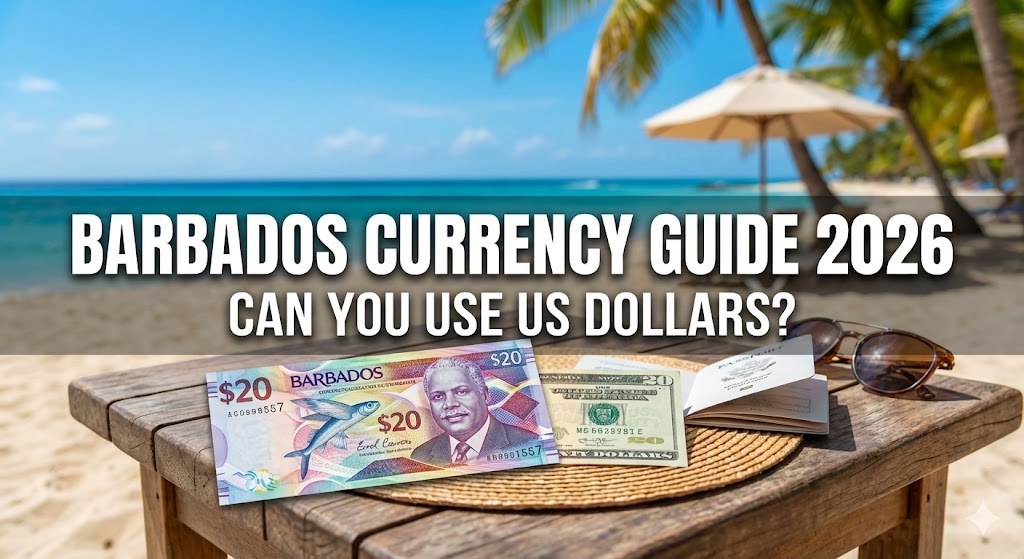
Welcome to Barbados currency guide. When planning a dream vacation to the Caribbean, the last thing you want to stress about is how you are going to pay for your morning coffee or your sunset rum punch. Budgeting for a trip is one thing, but understanding the local money mechanics is completely different. Do you need to visit a currency exchange before you fly? Can you just tap your credit card everywhere? And perhaps the most common question of all: Can you use US dollars?
If you are heading to the island in 2026, you are in luck. Managing your money here is surprisingly straightforward compared to many other international destinations. However, knowing the insider tips on exchange rates, ATM fees, and tipping etiquette can save you a significant amount of money.
This comprehensive, in-depth Barbados currency guide covers absolutely everything you need to know about paying your way around the island, ensuring you get the best value out of every single cent.
Barbados currency guide:What is the Official Currency in Barbados?
The official currency of the island is the Barbados Dollar. Its official international currency code is BBD, but you will often hear locals and tourists alike refer to it simply as “Bajan Dollars.” When looking at price tags in local shops or menus, prices are usually displayed with the standard dollar sign ($) or sometimes as BDS$ to avoid confusion with the US Dollar.
The currency is issued by the Central Bank of Barbados and comes in a variety of brightly colored notes and coins.
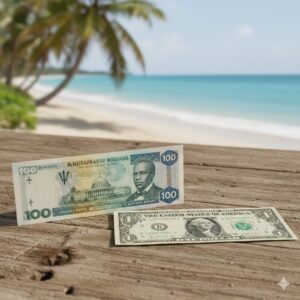
- Banknotes: The notes come in denominations of $2, $5, $10, $20, $50, and $100. A fun and unique feature of Bajan banknotes is that they are printed vertically rather than horizontally, featuring prominent Barbadian historical figures.
- Coins: Coins are available in 5 cents, 10 cents, 25 cents, and 1 dollar. The 1-dollar coin features the iconic flying fish, a national symbol of the island.
The Golden Rule: Can You Use US Dollars?
Yes, absolutely. This is perhaps the greatest convenience for American travelers and anyone who holds USD. You do not need to rush to a currency exchange bureau at your home airport before you depart.
The Barbados Dollar is permanently pegged to the United States Dollar at a fixed, unchanging exchange rate:
$2 BBD = $1 USD
Because of this fixed peg, US dollars are universally accepted almost everywhere across the island. From the ultra-luxury hotels on the [INTERNAL LINK: West Coast] to the smallest street food vendors serving macaroni pie at the legendary [INTERNAL LINK: Oistins Fish Fry], your American cash is welcome.
The “Change” Rule You Must Remember:
If you hand a vendor a US Dollar bill, you will almost always receive your change in Barbados Dollars. For example, if an item costs $10 BBD and you pay with a $10 USD bill (which equals $20 BBD), you will receive $10 BBD back in change. This is actually a highly convenient way to acquire local pocket money for small purchases without ever visiting a bank.
Note: While US paper bills are accepted, US coins generally are not.
What About Euros, GBP, or CAD?
Unlike the US Dollar, other major foreign currencies such as Euros, British Pounds (GBP), and Canadian Dollars (CAD) are not accepted for daily transactions at local shops, bars, or restaurants.
If you are traveling from the UK, Europe, or Canada, you have two choices:
- Bring your home currency and exchange it at a local commercial bank in Barbados. Banks will offer a much better exchange rate than the front desk of your hotel.
- Simply use your debit or credit card at a local ATM to withdraw Bajan Dollars directly from your home account.
Credit Cards vs. Cash: What You Need to Know
In 2026, Barbados is a highly modernized island, and electronic payments are the norm in most tourist-facing businesses.
Using Credit Cards
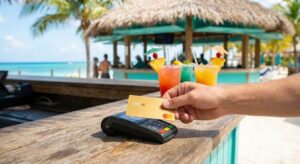
Visa and Mastercard are the undisputed kings here. They are widely accepted at hotels, restaurants, supermarkets (like Massy Stores), and by larger tour operators. American Express (Amex) and Discover are accepted at large international resorts, but smaller local businesses often decline them due to higher merchant fees.
Travel Tip: Always notify your bank that you are traveling to the Caribbean before your flight. If you don’t, their fraud prevention algorithms might block your card the first time you try to buy a rum punch!
Watch Out for Foreign Transaction Fees: If your credit card charges a 3% foreign transaction fee, those costs can add up quickly. Try to travel with a card that offers zero foreign transaction fees.
Using ATMs in Barbados
If you need cash, ATMs (often called cashpoints or ABMs locally) are plentiful. You will find them at the airport, in major towns like Bridgetown, Holetown, and Speightstown, and dotted along the busy South Coast.
ATMs will only dispense Barbados Dollars. Be aware that the local bank will likely charge a small withdrawal fee (usually around $5 to $10 BBD), and your home bank may charge an international withdrawal fee on top of that. To minimize fees, it is better to make one or two large withdrawals rather than several small ones.
Where Cash is Still King
While you can use plastic for your hotel and fancy dinners, you absolutely need to carry physical cash (either USD or BBD) for the following:
- Public Transport: Riding the local blue government buses or the yellow minivans costs exactly $3.50 BBD per ride. The blue buses require exact change in coins; they do not give change. (Read our full [INTERNAL LINK: Transport Guide] for more details).
- Beach Vendors: If you want to buy a fresh coconut, a handmade bracelet, or rent a beach chair and umbrella from a local operator.
- Rural Rum Shops: If you venture off the beaten path into the countryside, small local bars operate on a cash-only basis.
- Tipping: While you can add tips to a card, handing cash directly to the person who served you is always preferred.
Tipping Etiquette: How Much to Leave
The economy of Barbados relies heavily on tourism, and tipping is customary, expected, and highly appreciated by the hardworking staff.
- Restaurants and Bars: Most restaurants will automatically add a 10% to 15% service charge to your final bill. Always review your receipt carefully! If the service charge is already included, you are not obligated to leave more, though an extra few dollars for exceptional service is welcome. If it is not included, tipping 10% to 15% is the standard rule.
- Taxis: Taxis are unmetered, so you must agree on the fare before getting in. Tipping 10% of the agreed fare is normal practice.
- Hotel Staff: Leaving $2 to $5 USD per day for your housekeeping staff is a polite gesture. For bellhops who carry your bags, $1 to $2 USD per bag is standard.
Conclusion
Understanding the local money rules is the key to a stress-free vacation. The ultimate takeaway from this Barbados currency guide is simple: if you have US Dollars, bring them. They are as good as local cash. If you don’t, rely on your Visa or Mastercard and make a quick stop at a local ATM.
Now that your wallet is sorted and you know exactly how to pay, you can focus on the important things—like safely enjoying the sunshine. Be sure to check out our [INTERNAL LINK: Barbados Safety Guide] to ensure your trip is as secure as it is enjoyable!

Pingback: The Ultimate 7 Day Barbados Itinerary for First-Timers (2026)
Pingback: 5 Best Snorkeling Spots in Barbados: Sea Turtles & Wrecks (2026)